


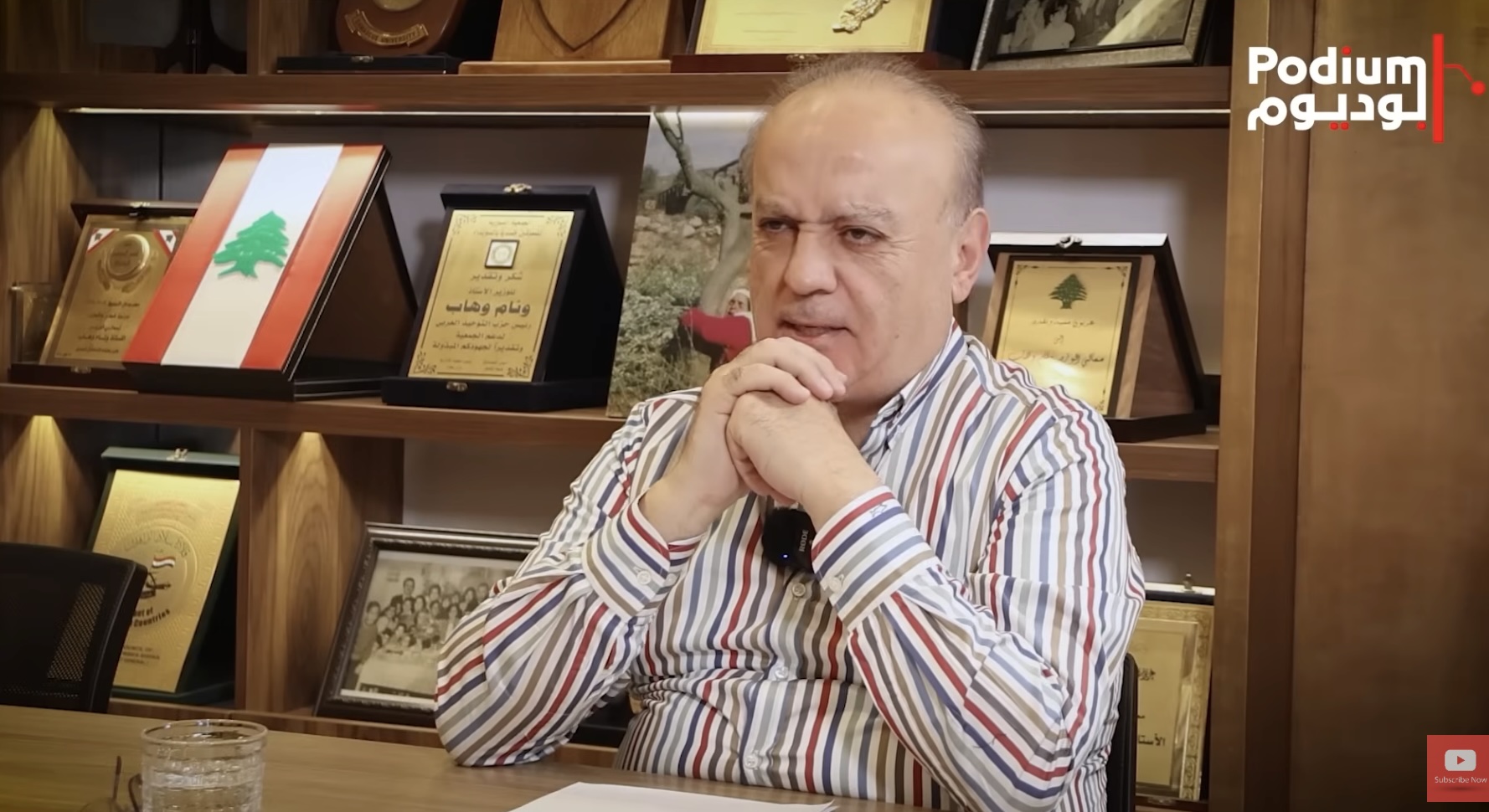
In an interview with journalist Maysem Rizk on the “Podium” platform, the head of the Arab Unification Party, former minister Wiam Wahhab, revealed details of what he called the “Prince Abu Omar File.” He spoke of “imaginary influence and paid promises” involving several political names, asserting that what transpired “exposes the falsity of those speaking in the name of sovereignty” because “the country is being run on WhatsApp,” as he put it.
Wahhab explained that this file—containing allegations, alleged influence, and paid political promises—cannot be treated as a passing incident or a marginal detail. Rather, it represents a flagrant example of how politics is conducted in Lebanon, where constitutional and legal institutions are replaced by unofficial channels, personal contacts, mediations, and deals struck far from any oversight or accountability.
He emphasized that the danger of this file lies not only in the individuals involved but in the political mentality that allows such events to pass, and in the implicit complicity or silence accompanying them. He argued that repeated talk of sovereignty and independence becomes worthless when the country is managed via “phones and WhatsApp” instead of a Council of Ministers or official institutions with clear powers.
The Role of MP Bahia Hariri and the Deception of “External Wills”
Wahhab noted that MP Bahia Hariri, with her political experience and shrewdness, played a fundamental role in exposing the falsity of the claims associated with this file. By directly verifying references and data, she caused the collapse of narratives that were being marketed as representing external wills or decisions. He stressed that this step revealed the extent of the contempt some involved parties hold for both public opinion and the state.
Wahhab questioned the behavior of several politicians and how they could accept dealing with “imaginary figures” or suspicious channels to achieve gains or positions, considering such behavior a blight on Lebanese political life that destroys remaining public trust.
National Security: Long-Term Truce and the Reality of Weaponry
On national and security matters, Wahhab’s position was clear:
-
Call for a Long Truce: He urged against being dragged into uncalculated military adventures, stressing that Lebanon cannot withstand additional wars or further destruction.
-
Elements of Strength: He clarified that calling for a truce does not mean accepting the stripping of power elements or leaving Lebanese citizens exposed to danger.
-
The Reality of Disarmament: Wahhab argued that talking about surrendering weapons is “unrealistic” given regional developments, the open Syrian conflict, the massive presence of displaced persons, and the spread of chaos on Lebanon’s borders.
He asserted that, at this stage, weapons are no longer confined to one group or sect but have become, in the eyes of many, an element of protection for anyone who feels threatened.
The State as the Ultimate Reference
Wahhab added that while the state remains the primary and final reference—and the main bet must be on the Lebanese Army and security forces—experience has shown that the state may sometimes fail to fulfill its full role. In such cases, he argued, people cannot be asked to surrender or wait for the unknown, noting that defending homes and villages is a legitimate right if chaos is imposed or protection is absent.
He clarified that any talk of “closing areas” or taking field measures is purely hypothetical, linked only to a state of total government collapse. The priority remains preventing a slide into chaos, maintaining civil peace, and fortifying the Lebanese interior against projects threatening its unity.
Conclusion: Beyond Empty Slogans
Wahhab concluded by stressing that Lebanon is not built on empty slogans or populist rhetoric that raises the banner of sovereignty while hollowing it of its substance. Instead, it is built on:
-
A state that respects itself.
-
Transparent politics.
-
Effective institutions.
-
Independent national decisions made within institutions, not in the corridors.
He called for a sincere national stance to restore the concept of the state and protect Lebanon from being turned into an arena for influence-peddling and shady deals.

