


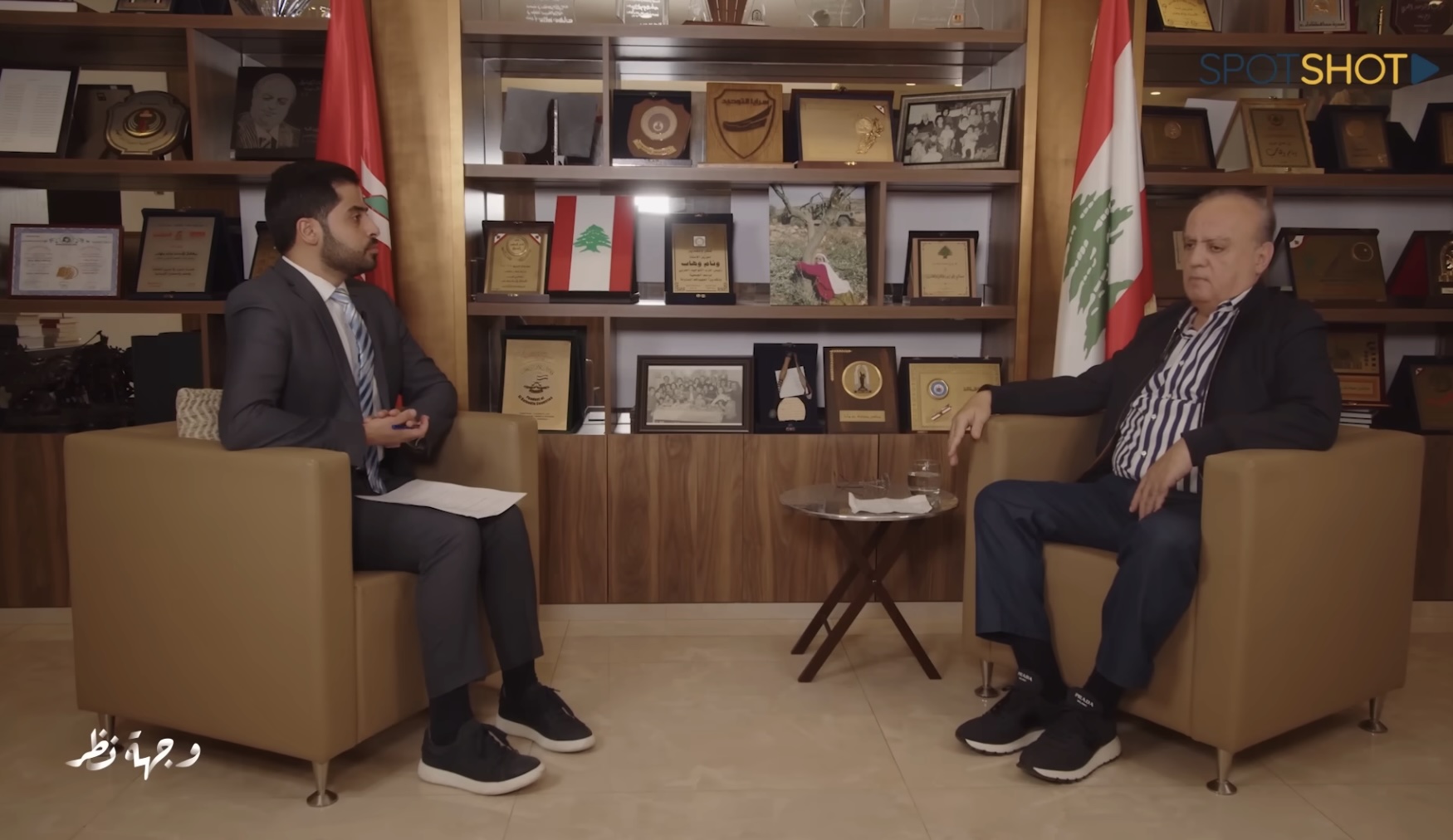
Within the program “Point of View” on the “Spot Shot” platform, the head of the Arab Unification Party, former minister Wiam Wahhab, called for “peace through direct negotiations” under clear conditions. He discussed the South, weaponry, domestic balances, and developments in Syria, Suwayda, and the Coast.
Wahhab presented a political approach based on Lebanon’s engagement in direct negotiations with Israel. These negotiations, according to him, should lead to border demarcation, the release of prisoners, and an Israeli withdrawal. He stated that “the opportunity for peace between Lebanon and Israel will not be repeated every day,” urging Lebanon to “seize this opportunity.”
During the interview, Wahhab distinguished between the concepts of “peace” and “normalization.” He argued that normalization is a “popular will,” while peace, according to his proposal, is linked to securing rights, ending the conflict, and achieving tangible gains regarding land, borders, and prisoners. He emphasized that the entire region, per his reading, is moving toward negotiation tracks, adding that Lebanon should not remain outside this path.
Wahhab’s Conditions for Negotiation Wahhab defined what he described as the appropriate formula for any direct negotiation through three essential elements: Israeli withdrawal, the release of prisoners, and land border demarcation (following the maritime demarcation). He considered that these conditions, if met, would open the door to a “natural peace” that can be built upon.
In this context, he spoke about the role of General Joseph Aoun, considering him “trustworthy” to handle the land border demarcation file. Recalling previous discussions on maritime lines, he stressed that what is required is a clear Lebanese decision followed by a clear negotiation path, rather than “formal details” related to seating arrangements or rooms.
South Lebanon: “Development Plan” and Economic Track Wahhab linked any peace track to a development plan for South Lebanon, in areas stretching “from Naqoura to Tyre.” He spoke of an economic approach including facilities, projects, and investment opportunities, especially in border villages that suffered extensive destruction. He pointed out that reconstruction should not remain a hostage to long waits or the political conditions that might accompany it.
He touched upon what he called the “American plan” circulating regarding an economic zone and factories on the “frontline,” stating it is not a reason for rejection. Instead, he said Southerners “should be happy,” linking this to the potential improvement of land value and opportunities. He raised questions such as, “Hasn’t the time come for the Shiites to rest?”, in the context of the accumulated cost of conflicts on the South and its environment.
Reconstruction and the Iranian Role Regarding reconstruction, Wahhab expressed skepticism about launching the process quickly “without political conditions.” Alternatively, he proposed that the Iranians, or those with the financial capacity, start paying money directly to the people to provide reassurance and begin the building process. He asserted that people must receive their entitlements first, and political discussions can follow later.
Domestic Affairs, Weaponry, and Political Responsibility On internal matters, Wahhab warned against placing the burden of the “weapons and peace” file on General Joseph Aoun alone, as it might later open the door to accusatory rhetoric like “the Maronite’s betrayal.” He called for Parliament Speaker Nabih Berri and Prime Minister Nawaf Salam, alongside the Presidency, to collectively bear the responsibility of this path, ensuring any major step is managed through broad political consensus.
He also noted talk in “some salons” about indirect negotiations with “The Party” (Hezbollah) regarding peace and the future of the conflict, without providing details. He pointed out that the State must decide its position; otherwise, international powers may move to negotiate with the “strongest” on the ground.
Syria, the Coast, Suwayda, and Warnings of Escalation In another part of the interview, Wahhab addressed the Syrian situation, considering President Ahmed al-Sharaa’s position “difficult and unenviable.” He predicted that the Syrian coast is “facing certain developments,” while criticizing the Syrian State’s handling of Suwayda, likening it to an attempt to enter the city “through sewage pipes rather than its main doors.”
In the most prominent escalation during the interview, Wahhab stated that any move against Suwayda would lead to the shelling of Damascus. He mentioned that this might not be via Israeli aircraft, but “through missiles,” stating that the Druze possess capabilities to strike Damascus “without resorting to the Israelis.” He noted that “the youth are active on Mount Hermon (Jabal al-Sheikh).”
Through these positions, Wahhab presented a reading that combines an explicit call for direct negotiations with Israel under specific conditions, linking any understanding to a Southern development plan, while warning against unilateral domestic management of this path—parallel to a sharp approach toward developments in Syria, particularly Suwayda and the Coast.

